
Indiana Certified Crop Adviser (CCA) of the Year Award
Consider nominating a qualified CCA you employ or know for the “Indiana Certified Crop Adviser of the Year Award”. This award will recognize an individual who has performed superior service for their farmer clients in nutrient management, soil and water management, pest and crop production.
The purpose of our Indiana award program is to increase the awareness to other CCAs and their farmer customers that their service providers strive to do their best not only in making economically sound cropping decisions but also ones that are environmentally sound. With increasing farm size, complexity of management options, and increasingly complex regulations, we foresee farmers relying more and more on the advice of specialists who are CCAs.
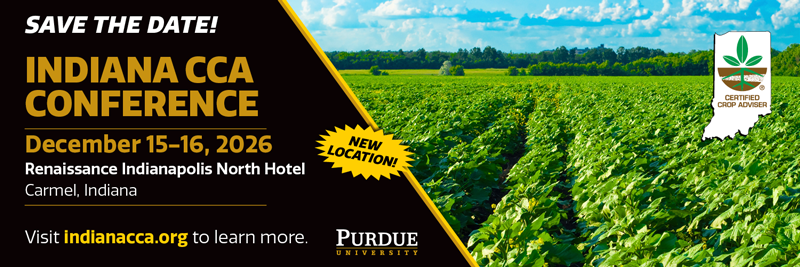
The award will be presented to the winner at the Indiana Certified Crop Adviser Conference on December 15-16, 2026. The nominator, if not the nominee’s employer, that submits the winning application will receive $250 and the CCA winner will receive $1,500. In addition, the winner will be nominated to the International CCA Board for consideration for the International CCA of the Year Award with an honorarium of $2,000.
To be considered for the Indiana Certified Crop Adviser Award, a CCA must be certified in Indiana and nominated by a client, a colleague, or the employer of the CCA who knows their qualifications.
A nomination form, letter of recommendation form, and tips for completing the nomination are included. Please feel free to copy and distribute to those who might be using services of a CCA.
The nomination should include
- Nomination form
- Three letters of recommendation
- one from the CCA's employer and two from customers
- Three letters of recommendation may come from customers if the CCA is self-employed.
Nominations must be received by November 16, 2026. If you have any questions, please contact Mershon Tobin at info@indianacca.org.
NEW CCA Ethics CEU Requirement
Beginning January 1, 2026, all CCAs will need one hour of ethics education as part of the existing 40.0 CEU requirement. Most activities will require CCAs to self-report the CEU. Books do not qualify, but employer ethics modules do. More details and resources will be shared throughout 2026.
Short FAQs
What’s new in 2026?
All CCAs must complete 1.0 Ethics CEU within their 40.0 CEU requirement.
How can I earn the Ethics CEU?
Options include future webinars or articles offered through the ASA program, employer-provided ethics training, or a board-hosted ethics session.
Do I need to self-report?
For most activities, yes. Program-hosted webinars will be recorded automatically, but employer trainings and board sessions must be self-reported with documentation.
Do books count?
No. Unlike some other certifications, reading a book does not qualify for Ethics CEUs for CCAs.
What about employer ethics modules?
Yes—if they cover professional ethics relevant to crop advising, they may count as self-reported Ethics CEUs.
Will more opportunities be available?
Yes. Additional webinars and articles will be offered throughout 2026, giving CCAs multiple ways to meet the requirement without scrambling at the last minute.
Who can I contact with questions?
Reach out to support@sciencesocieties.org for assistance or to suggest resources.
Bobby Busick is the 2025 Indiana CCA of the Year!
Trust guides agronomist’s work with farmers
The 2025 Indiana Certified Crop Adviser of the Year puts trust at the center of his success across a four-decade career. And he says it’s priority No. 1 for the next generation.

You’ll likely find Bobby Busick behind the wheel of his Premier Ag pickup truck.
A co-op account manager and 2025 Indiana Certified Crop Adviser of the Year, this agronomist has built his career from that seat, traversing his territory in southern Indiana for over four decades. He’s weathered more than a few tight farming years and navigated several company mergers, but his focus has remained constant for 42 years: Serve the farmers.
“It’s just something I love,” Busick said. “It’s just a passion I’ve always had.”
Setting his roots
That passion stems from Busick’s childhood growing up on his family’s farm in Orleans, Ind. He recalled his decision to skip college and dive straight into the ag industry.
“My teachers all tried to get me to go to college, and I said with farming, you don’t need a college degree,” he chuckled. “Boy, was I ever wrong. In today’s world, you need a college degree to farm.”
Instead, Busick completed the Purdue University short course for farming and then started as a backup fuel driver and liquid applicator for the Orange County Cooperative. He moved to sales shortly thereafter, where he remains today.
Obtaining the certified crop adviser title when it was first offered was important to Busick. It would add to his credibility and guide his agronomic recommendations when he was just getting his feet wet. But learning to connect with the farmers he served was arguably Busick’s top goal as a new agronomist, and he said it’s the greatest challenge for the next wave of agronomists filling his shoes.
Building trust
A volatile industry like farming calls for a heavy dose of trust in the agronomists, salespeople and advisers in a growers’ circle. Busick falls in that circle, meaning that trust was something he sowed from the beginning. He didn’t employ fancy gimmicks to gain farmers’ trust. So what did it take?
“The No. 1 thing is just being honest and truthful with them,” Busick said. “A farmer doesn’t care if you don’t know something. Instead of telling them to do something and being wrong, just be honest and tell them what you don’t know. But they’ll never forget if something’s wrong.”
Being down-to-earth with farmers is something that has always come naturally to Busick. Although he’s a salesman, he doesn’t only show up to the farm to make a sale. Rather, he’s there as a sounding board, an agronomic expert and a friend.
“Sometimes, you just need to stop and chit-chat,” he added. “You just need to be a guy’s friend.”
Just show up
Here’s Busick’s call to action for new agronomists: Take time to talk, get to know the growers you serve, pull into the farm or pick up the phone, and build trust with farmers.
“In today’s fast-paced world, the younger generation doesn’t like to take the time to sit down and just chit-chat because they’re always too busy,” he explained. “But yet, you still have to do some of it to keep going.”
Sitting next to Busick during the interview, Allison Jones’ ears perked up. A fellow Orleans native, Jones is a senior at Purdue studying agronomy and spent her summer riding along with Busick, learning the tricks of the trade. She’s seen firsthand how those diligent communication efforts pay off in building lasting relationships.
“We just have to keep showing up, even if it’s not easy or we don’t think we have the time,” Jones said. “But we just have to keep doing that to build trust.”
Showing up is what Busick continues to do — from that seat of the pickup truck with the same values he had on Day 1.
Indiana CCA Awards
Click the links below for more information about our award applications!

Stay Updated!
Looking for more information about the upcoming conference? Stay updated and follow us on social media to get the latest information as it becomes available.


Apps for CCAs
Indiana CCA Conference App
Review the program and plan your conference with the Indiana CCA conference program app! Explore the program, flag favorite speakers and topics, and build your personalized conference program.
 iOS App
 Android App
Certified Crop Adviser App
Use the CCA App to scan the QR codes and get your CEUs added to your account within 24 hours simply by signing in with your mobile device.
iOS App
Android App